
The Mind Behind the Machine. Ignazio Infantino and the Intelligence That Remanufacturing Still Needs.
Ignazio Infantino has spent his career on the difference between a machine that sees and one that understands. At EuAReman 2026, that distinction becomes industrial policy.

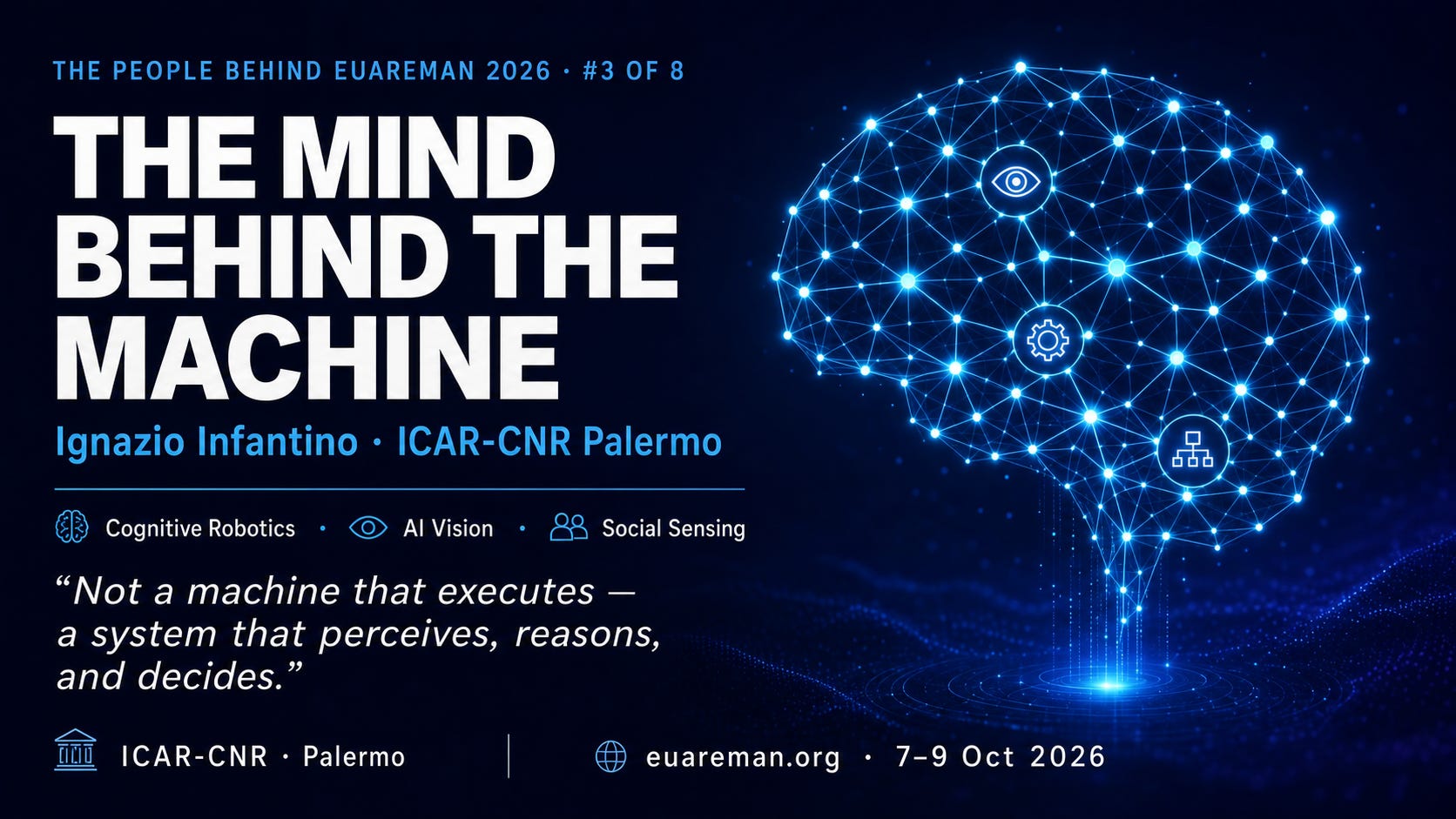
A machine that can see is impressive. A machine that can understand what it sees — that can interpret context, infer intention, decide what to do next in conditions that no programmer anticipated — is something else entirely.
Ignazio Infantino has spent his career on that distinction.
A researcher at ICAR-CNR in Palermo, Infantino works in the laboratory of Cognitive Robotics and Social Sensing — a research group whose name already announces its ambition: not robots that execute, but systems that perceive, reason and interact. His work spans computer vision, three-dimensional scene reconstruction, the automatic understanding of human actions, knowledge representation for robotics and natural interfaces. In 2012 he published on cognitive architectures for affective human-robot interaction. In 2013, a chapter on the same theme appeared in the Journal of Advanced Robotic Systems. The thread running through it all is the question that cognitive science and engineering have been circling together for decades: what does it mean for an artificial system not merely to perform a task, but to understand it?
The laboratory he works in is explicit about its mission. Cognitive robotics investigates new architectures to improve the “perception-understanding-action” cycle of autonomous systems, drawing on human cognitive models as a reference. The work on social sensing is complementary: the enormous quantity of data available on the internet about human social behaviour, if correctly interpreted, can constitute a powerful knowledge base for building systems that operate in real-world human environments. Together, these two strands of research produce something that neither produces alone: systems that can be deployed not in controlled industrial settings with predictable variables, but in the messy, unpredictable conditions of real operations.
This matters for remanufacturing in ways that the sector is only beginning to articulate clearly.
Consider what happens at a disassembly station when a used product arrives. The product has a history. Perhaps it is an electric motor that ran for six years in a cement factory — dusty, thermally stressed, bearing the marks of occasional overloading and one amateur repair. Perhaps it is a hydraulic pump from a construction site in a tropical climate, with seal degradation patterns that no European factory engineer has encountered before. The information that determines whether each component can be restored, upgraded or must be scrapped is embedded in the physical state of the object — in wear patterns, surface conditions, micro-damage signatures that are invisible to a camera trained only to match images to templates.
A cognitive system — one that has learned from thousands of previous disassembly decisions, that can read context, that can ask “what is this object, where has it been, and what has that done to it?” — is not a luxury for a remanufacturing operation. It is the condition of possibility for remanufacturing at scale. Without it, every non-standard product that arrives at the line requires a human expert to make the assessment manually. With it, the expert’s knowledge can be distributed, replicated, and deployed at speeds that manual inspection cannot match.
Infantino’s presence on the EuAReman 2026 Organising Committee is, in this light, not decorative. It represents a deliberate choice by the committee to embed the cutting edge of AI and cognitive systems research into the intellectual architecture of the workshop — not as a separate track, but as a thread woven through the whole. The call for abstracts includes Training, Capacity Building and AI/IoT for Remanufacturing as one of its ten thematic areas. It is not an afterthought. It is a recognition that the future of the sector will be decided, in large part, by how successfully it absorbs the advances that researchers like Infantino are producing today.
In October, when researchers from two continents gather at CNR to discuss what remanufacturing will look like in the next decade, the conversations that matter most may be the ones that happen over lunch — between the engineer from Lagos who has solved, by necessity, a problem that the Palermo laboratory has been studying theoretically, and the cognitive systems researcher who has the tools to formalise what the Lagos engineer has been doing intuitively for years.
Ignazio Infantino will be at that lunch.
📅 7–9 October 2026 · CNR + Palazzo Chiaramonte-Steri, Palermo
📥 Submit your abstract: euareman.org/abstract-submission · Deadline 30 June 2026